What Is Software Regression Testing?
Software regression testing is the process of re-running tests on an application after changes — new features, bug fixes, configuration updates, or third-party integrations — to confirm nothing that previously worked has broken.
It’s a black-box technique: testers don’t need to know how the code was changed internally, only whether the existing, expected behavior still holds. A single line of code changed to fix one bug can quietly break three unrelated features elsewhere in the app — regression testing exists specifically to catch that kind of ripple effect before your users do.
Unlike testing brand-new functionality, regression testing is about protecting what’s already stable. It’s the safety net that lets your team ship changes quickly without constantly worrying about what might silently break.
Why Regression Testing Matters
Types of Regression Testing
Corrective Regression Testing
Used when there's no change to existing requirements — re-running existing test cases to confirm a bug fix didn't disturb anything else.
Progressive Regression Testing
Used when requirements have changed and new test cases are needed alongside existing ones to validate both old and new functionality together.
Selective Regression Testing
Re-testing only the modules impacted by a specific change, instead of the entire application — faster and more cost-efficient for large systems.
Complete Regression Testing
A full re-run of the entire test suite, typically used before a major release or when changes touch multiple core modules.
Automated Regression Testing
Running regression suites through automation frameworks instead of manually, ideal for applications with frequent releases, large test suites, or stable, repetitive workflows. This is where automated regression testing pays off most cutting execution time significantly compared to manual re-runs, especially for suites that get executed after every single build.
Regression Testing Methods We Use
The testing strategies we deliver
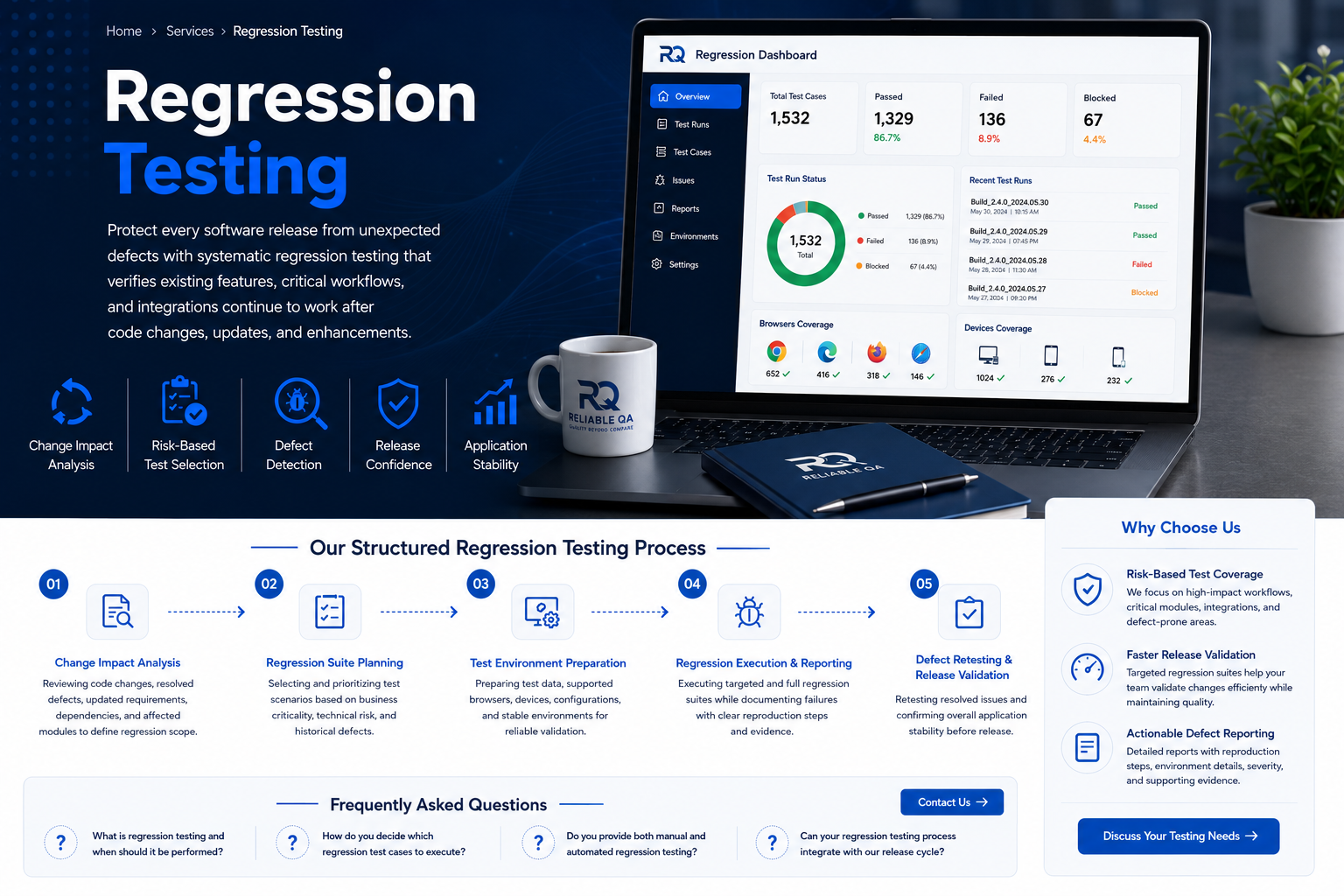
Before writing a single test case, our engineers dissect your project specifications, user stories, and technical documentation. We identify potential logical gaps early to align our testing scope perfectly with your development goals.
We architect a customized QA strategy defining test scenarios, automation frameworks, and environment matrices. Detailed test cases are structured to maximize test coverage across every feature, platform, and edge case.
Our team runs comprehensive manual and automated test suites, uncovering hidden defects and performance bottlenecks. Every issue found is documented with clear reproduction steps, environment details, and clear logs for your development team.
Once patches are deployed, we retest the resolved bugs and execute deep regression sweeps to guarantee that newly updated code has not disrupted your existing application stability.
When Should Regression Testing Be Performed?
- After any bug fix, no matter how small
- After adding a new feature or enhancement
- After refactoring or restructuring existing code
- After updating third-party libraries, APIs, or integrations
- Before every major release or deployment
- During CI/CD pipeline runs, on every build
How We Select Test Cases for Regression Testing
- Test cases tied to frequently reported defects
- Core, highly visible user-facing features
- Business-critical functionality (checkout, authentication, payments)
- All integration test cases and cross-module dependencies
- Complex logic and calculation-heavy test cases
- Boundary value and edge-case scenarios
- A representative mix of previously passing and previously failing test cases
Our Regression Testing Process
Requirements Analysis
Step description here.
Test Case Planning
We build detailed test scenarios covering functionality, usability, compatibility, user journeys, and edge cases.
Environment Preparation
We set up testing environments that match your real production conditions — devices, browsers, operating systems, and configurations included.
Execution & Reporting
Our QA specialists run manual and exploratory tests, then document every issue with clear reproduction steps and screenshots.
Regression Verification
Once fixes are made, we re-test to confirm the issue is resolved and nothing else broke — then give a final sign-off.
Tools & Technologies We Use
Selenium · Playwright · Cypress · Katalon Studio · TestComplete · BrowserStack · JIRA
Benefits of Our Regression Testing Services
- Higher Software Stability — Fewer post-release surprises, more predictable builds
- Lower Long-Term Cost — Catching regressions early is far cheaper than post-launch fixes
- Faster Release Cycles — Automated regression testing shortens the QA gate before every deployment
- Stronger Release Confidence — Your team ships knowing existing functionality has been verified
Why Choose Us
Why Choose Us for Regression Testing Services
At ReliableQA, we use a practical, risk-based regression testing approach to protect existing functionality while helping your team release with confidence. Our testing strategy combines manual and automated testing based on your application and release cadence.
FAQ
Frequently asked questions
What is regression testing in software testing?
It’s the process of re-testing an application after changes to confirm existing features still work as expected — protecting stable functionality from new-code side effects.
What’s the difference between regression testing and retesting?
Retesting verifies that a specific known bug is fixed. Regression testing checks that the fix (or any other change) hasn’t broken anything else in the application.
Do you offer automated regression testing?
Yes. We build automated regression suites for stable, frequently repeated workflows, while using manual QA regression testing for newer or exploratory scenarios.
How often should regression testing be performed?
Ideally after every code change — bug fix, new feature, or integration update — and always before a major release. Teams running CI/CD typically automate this into every build.
How do you decide what to include in a regression suite?
Through change impact analysis and risk-based prioritization — factoring in affected modules, business-critical workflows, defect history, and frequently used features.
Can regression testing be integrated into our CI/CD pipeline?
Yes. We align regression cycles with Agile sprints, scheduled releases, and CI/CD workflows so testing runs automatically alongside your existing deployment process.