Sanity Testing Services for Fast and Reliable Release Validation
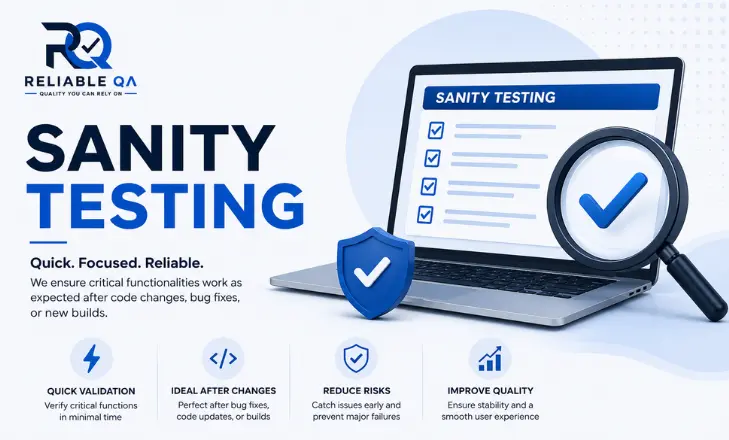
Sanity testing is a targeted software testing activity performed after code modifications, bug fixes, configuration updates, or feature enhancements. Rather than testing the entire application, sanity testing focuses specifically on the areas affected by recent changes and their related functionality.
Our software sanity testing services help businesses confirm that updates have been implemented correctly and that essential workflows remain stable. This approach allows development and QA teams to quickly determine whether a build is suitable for deeper testing activities such as regression testing, user acceptance testing, or production deployment.
For organizations operating in Agile and DevOps environments, QA sanity testing plays an important role in maintaining release quality without slowing delivery cycles. By concentrating testing efforts where risk is highest, teams can detect critical issues faster and reduce unnecessary testing effort.
Why Sanity Testing Matters
Sanity testing helps teams quickly verify that recent software changes, bug fixes, and feature updates are working as expected before investing time in extensive testing. By focusing on the most critical affected areas, sanity testing reduces release risks, accelerates development cycles, and ensures application stability, helping organizations deliver high-quality software with greater confidence.
Our Structured Sanity Testing Processss
Build & Change Verification
We review the latest build, release notes, bug fixes, feature updates, and deployment changes to identify exactly what requires validation.
Sanity Test Case Selection
We select only the critical QA sanity testing scenarios that validate the modified functionality and its immediate business impact instead of executing a complete regression suite.
Test Planning
We create a focused test scope covering the highest-risk areas and business-critical functionality.
Software Sanity Testing Execution
Our testers execute targeted test cases to verify that bug fixes, enhancements, and recent code changes function correctly without affecting essential application behavior.
Related Functionality Validation
We verify closely connected workflows, integrations, UI elements, and data flow to ensure the implemented changes have not introduced unexpected issues.
Defect Reporting & Developer Feedback
Any failed sanity checks are documented with detailed reproduction steps, screenshots, severity, expected results, and recommendations for quick resolution.
Build Approval & Next Testing Phase
Once all critical sanity checks pass, we confirm the build is stable and recommend proceeding with regression testing, UAT, or production deployment.
Our Areas of Specialization
Our sanity testing services support a wide range of applications and business environments. We help organizations validate recent software changes, verify critical functionality, and ensure operational stability across web, mobile, enterprise, and cloud-based platforms before release.
Web Application Testing
Validation of forms, user workflows, navigation paths, business logic, and essential website functionality after updates or enhancements.
Mobile Application Testing
Verification of new features, UI changes, and application performance across Android and iOS devices to ensure a consistent user experience.
SaaS Platform Testing
Assessment of subscription workflows, account management, dashboards, reporting modules, and customer-facing features impacted by recent changes.
API & Integration Testing
Validation of APIs, third-party integrations, payment gateways, data exchanges, and connected services to ensure seamless communication between systems.
Enterprise Application Testing
Testing of complex business processes, user permissions, reporting functions, and operational workflows within ERP, CRM, and enterprise platforms.
E-commerce Testing
Verification of product browsing, shopping carts, checkout processes, promotions, order management, and payment functionality following updates.
When Is Sanity Testing Required?
• After bug fixes
• After sprint releases
• Following configuration changes
• Before regression testing
• Prior to user acceptance testing
• Before production deployment
• After API updates
• Following hotfix implementations
Deliverables Included
• Test Execution Summary
• Defect Reports
• Screenshots and Supporting Evidence
• Severity Classification
• Risk Assessment
• Retesting Results
• Release Readiness Recommendation
Sanity Testing vs Smoke Testing
Sanity testing focuses on verifying specific changes and affected functionality after modifications are made. Smoke testing, on the other hand, evaluates whether a new build is stable enough for detailed testing. While smoke testing covers broader functionality, sanity testing concentrates on validating targeted changes and their impact.
Industries We Support
• SaaS and Software Products
• FinTech Applications
• Healthcare Platforms
• E-commerce Solutions
• Education Technology Systems
• Logistics and Supply Chain Platforms
• Manufacturing Applications
• Enterprise Business Systems
Why Choose Us
Why Choose ReliableQA
ReliableQA combines technical expertise, business understanding, and proven testing methodologies to help organizations release software with confidence. Our sanity testing services focus on validating critical changes quickly and accurately, enabling faster releases while maintaining application quality and stability.
Experienced QA Specialists
Our testing professionals understand modern development practices and focus on high-risk areas where defects are most likely to impact software performance and user experience.
Business-Focused Validation
We prioritize the workflows and features that matter most to your customers, operations, and revenue, ensuring critical business functions remain reliable after every update.
Flexible Engagement Models
Whether you need support for a single release, an ongoing project, dedicated QA resources, or a long-term testing partnership, our services adapt to your requirements.
Transparent Communication
Receive clear test reports, detailed defect documentation, regular progress updates, and actionable recommendations throughout the testing process.
Independent Quality Assessment
As an external software testing partner, we provide unbiased validation and objective feedback, helping teams make informed release decisions with confidence.
FAQ
Frequently asked questions
Sanity testing is a focused testing approach used to verify that recent changes, fixes, or updates work correctly and do not negatively affect critical functionality.
Sanity testing validates specific changes, while regression testing evaluates broader application functionality to ensure existing features continue working.
It helps identify critical issues early, reduces wasted testing effort, and improves release confidence.
Certain checks can be automated, but many sanity testing activities benefit from experienced manual validation.
The timeline depends on the scope of changes and application complexity, but it is typically completed quickly to support rapid release decisions.
Yes. In addition to Sanity Testing, ReliableQA offers Manual Testing, Automation Testing, Smoke Testing, API Testing, and Web Application Testing services to help businesses ensure software quality throughout the development lifecycle. We also provide specialized testing solutions for mobile applications, including Google Play Store Testing, based on your project requirements.
Ready to Improve Release Confidence?
Every software release carries risk. Reliable QA helps organizations reduce that risk through focused sanity testing services that validate critical changes before they impact users. Whether you are preparing for a sprint release, production deployment, or major update, our QA specialists provide the expertise and insight needed to support stable, reliable software delivery.
Contact Reliable QA today to discuss your project and learn how our sanity testing services can strengthen quality, accelerate releases, and improve confidence in every deployment.